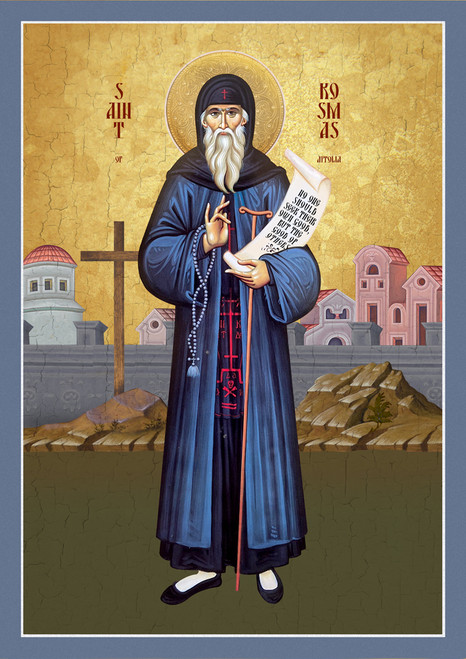


Saint Kosmas the Poet, Bishop of Maiuma
Commemorated October 12th
Saint Kosmas was born in Damascus, modern-day Syria, but he was orphaned at a young age. He was adopted by Sergius, the father of Saint John of Damascus (ca.676 - 749), and became John's foster-brother. The teacher of the two boys was an elderly Calabrian monk, also named Kosmas (known as "Kosmas the Monk" to distinguish him), who had been freed from slavery to the Saracens by John's father. John and Kosmas went from Damascus to Jerusalem, where both became monks in the monastery of Saint Sabbas the Sanctified. Together they helped defend the Church against the heresy of iconoclasm. Kosmas left the monastery in 743 when he was appointed Bishop of Maiuma, the port of ancient Gaza. He outlived John by many years and died in great old age.
As a learned prose-author, Saint Kosmas wrote commentaries, or scholia, on the poems of Gregory of Nazianzus. He is regarded with great admiration as a poet. Kosmas and John of Damascus are considered to be the best representatives of the later Greek classical hymnography, the most characteristic examples of which are the artistic liturgical chants known as "canons". They worked together on developing the Octoechos.
In the Eastern Orthodox Church, Kosmas has been called "a vessel of divine grace" and "the glory of the Church." He composed the solemn canons for Matins of Lazarus Saturday, Palm Sunday, the Triodes (canons with only three Canticles) which are chanted during Holy Week, the first canon of the Nativity (based on a Nativity sermon by Gregory the Theologian), and is known for his finest work, "Canon for Christmas Day". Altogether, fourteen canons are attributed to him in the liturgical books of the Orthodox Church. His most well-known composition is "More honourable than the cherubim…" (which is included in the Axion Estin), sung regularly at Matins, the Divine Liturgy and other services.
The hymns of Kosmas were originally intended for the Divine Services of the Church of Jerusalem, but through the influence of Constantinople their use became universal in the Orthodox Church. It is not certain, however, that all the hymns ascribed to Kosmas in the liturgical books were really his compositions, especially as his teacher of the same name was also a hymn writer.