
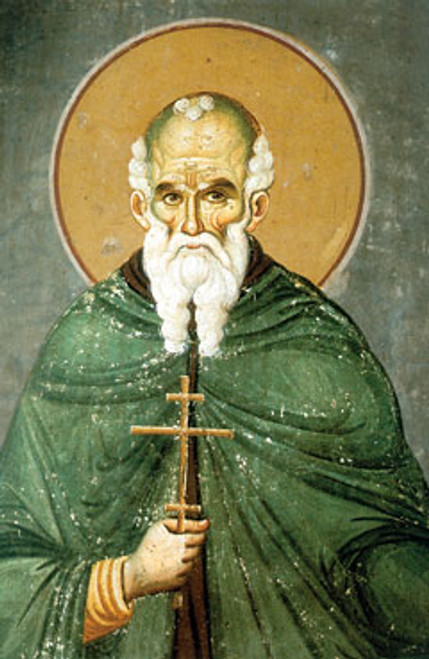

St. Athanasios of Great Lavra + Commemorated on July 5
Saint Athanasius of Athos, in holy Baptism named Abraham, was born in the city of Trebezond. He was orphaned at an early age, and being raised by a certain good and pious nun, he imitated his adoptive mother in the habits of monastic life, in fasting and in prayer. Doing his lessons came easily and he soon outpaced his peers in study.
After the death of his adoptive mother, Abraham was taken to Constantinople, to the court of the Byzantine emperor Romanus the Elder, and was enrolled as a student under the renowned rhetorician Athanasios. In a short while the student attained the mastery of skill of his teacher and he himself became an instructor of youths. Reckoning as the true life that of fasting and vigilance, Abraham led a strict and abstinent life, he slept little and then only sitting upon a stool, and barley bread and water were his nourishment. When his teacher Athanasios through human weakness became jealous of his student, blessed Abraham gave up his teaching position and went away.
During these days there had arrived at Constantinople Saint Michael Maleinos (July 12), igumen of the Kyminas monastery. Abraham told the igumen about his life, and revealed to him his secret desire to become a monk. The holy Elder, discerning in Abraham a chosen vessel of the Holy Spirit, became fond of him and taught him much in questions of salvation. One time during their spiritual talks Saint Michael was visited by his nephew, Nikēphóros Phocas, a military officer and future emperor. Abraham’s lofty spirit and profound mind impressed Nikēphóros, and all his life he regarded the saint with reverent respect and with love. Abraham was consumed by his zeal for the monastic life. Having forsaken everything, he went to the Kyminas monastery and, falling down at the feet of the holy igumen, he begged to be received into the monastic life. The igumen fulfilled his request with joy and tonsured him with the name Athanasios.
With long fasts, vigils, bending of the knees, with works night and day Athanasios soon attained such perfection, that the holy igumen blessed him for the exploit of silence in a solitary place not far from the monastery. Later on, having left Kyminas, he made the rounds of many desolate and solitary places, and guided by God, he came to a place called Melanos, at the very extremity of Athos, settling far off from the other monastic dwellings. Here the monk made himself a cell and began to live an ascetical life in works and in prayer, proceeding from exploit to exploit towards higher monastic attainment.
Brethren flocked to the monastery from everywhere, not only from Greece, but also from other lands, simple people and illustrious dignitaries, desert-dwellers having labored in asceticism for long years in the wilderness, igumens from many monasteries and hierarchs wanting to become simple monks in the Athos Lavra of Saint Athanasios. The saint established at the monastery a cenobitic monastic Rule on the model of the old Palestinian monasteries. Divine services were served with all strictness, and no one was so bold as to talk during the services, nor to come late or leave the church without necessity. The brethren grew in number, and the construction work at the Lavra continued. Saint Athanasius, foreseeing the time of his departure to the Lord, prophesied about his impending end and besought the brethren not to be troubled over what he foresaw. “For Wisdom disposes otherwise than as people judge.”
Troparion — Tone 3
The ranks of Angels were awed by your life in the flesh, how in the body, you went forth toward invisible struggles, O renowned one, and smote the hordes of demons with mortal wounds; for this reason, Athanasios, Christ rewarded you with abundant gifts. Therefore, O Father, pray that our souls may be saved.
Kontakion — Tone 2
Taking the yoke of Christ upon yourself, you bore your cross on your shoulders, O Athanasios; you became a most virtuous imitator of His sufferings, and a sharer of His glory, partaking of endless joy.


