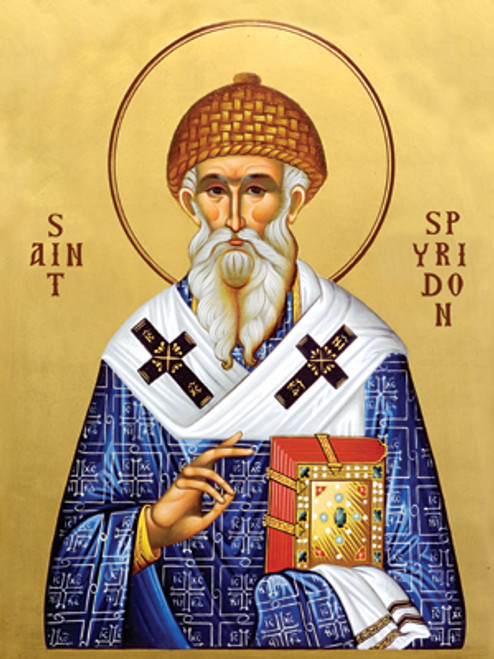


St. George + Commemorated on April 23
The Holy Great Martyr George the Victory-Bearer, was a native of Cappadocia (a district in Asia Minor), and he grew up in a deeply believing Christian family. His father was martyred for Christ when George was still a child. His mother, owning lands in Palestine, moved there with her son and raised him in strict piety.
When he became a man, Saint George entered into the service of the Roman army. He was handsome, brave and valiant in battle, and he came to the notice of the emperor Diocletian (284-305) and joined the imperial guard with the rank of comites, or military commander.
The pagan emperor, who did much for the restoration of Roman might, was clearly concerned with the danger presented to pagan civilization by the triumph of the Crucified Savior, and intensified his persecution against the Christians in the final years of his reign. Following the advice of the Senate at Nicomedia, Diocletian gave all his governors full freedom in their court proceedings against Christians, and he promised them his full support.
Saint George, when he heard the decision of the emperor, distributed all his wealth to the poor, freed his servants, and then appeared in the Senate. The brave soldier of Christ spoke out openly against the emperor’s designs. He confessed himself a Christian, and appealed to all to acknowledge Christ: “I am a servant of Christ, my God, and trusting in Him, I have come among you voluntarily, to bear witness concerning the Truth.”
“What is Truth?” one of the dignitaries asked, echoing the question of Pontius Pilate. The saint replied, “Christ Himself, Whom you persecuted, is Truth.”
Stunned by the bold speech of the valiant warrior, the emperor, who had loved and promoted George, attempted to persuade him not to throw away his youth and glory and honors, but rather to offer sacrifice to the gods as was the Roman custom. The confessor replied, “Nothing in this inconstant life can weaken my resolve to serve God.”
Then by order of the enraged emperor the armed guards began to push Saint George out of the assembly hall with their spears, and they then led him off to prison. But the deadly steel became soft and it bent, just as the spears touched the saint’s body, and it caused him no harm. In prison they put the martyr’s feet in stocks and placed a heavy stone on his chest.
The next day at the interrogation, powerless but firm of spirit, Saint George again answered the emperor, “You will grow tired of tormenting me sooner than I will tire of being tormented by you.” Then Diocletian gave orders to subject Saint George to some very intense tortures. They tied the Great Martyr to a wheel, beneath which were boards pierced with sharp pieces of iron. As the wheel turned, the sharp edges slashed the saint’s naked body.
At first the sufferer loudly cried out to the Lord, but soon he quieted down, and did not utter even a single groan. Diocletian decided that the tortured one was already dead, and he gave orders to remove the battered body from the wheel, and then went to a pagan temple to offer thanks.
At this very moment it got dark, thunder boomed, and a voice was heard: “Fear not, George, for I am with you.” Then a wondrous light shone, and at the wheel an angel of the Lord appeared in the form of a radiant youth. He placed his hand upon the martyr, saying to him, “Rejoice!” Saint George stood up healed.
When the soldiers led him to the pagan temple where the emperor was, the emperor could not believe his own eyes and he thought that he saw before him some other man or even a ghost. In confusion and in terror the pagans looked Saint George over carefully, and they became convinced that a miracle had occurred. Many then came to believe in the Life-Creating God of the Christians.
Troparion — Tone 4
As the liberator of captives and defender of the poor, physician of the sick, and champion of kings, O Victory-bearer Great Martyr George, intercede with Christ God to save our souls.
Troparion — Tone 4
You contested with an excellent deed, O passion-bearer of Christ, by faith you denounced the iniquity of the torturers, offering yourself as a sacrifice pleasing to God; therefore you received a crown of victory, and by your intercessions O Saint, you obtain the forgiveness of sins for all.