

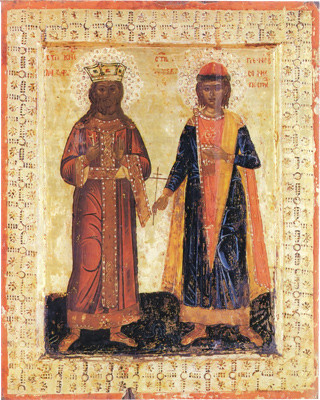
Czar-Martyr Lazar and St. George the New + Commemorated on June 15
Saint Tsar Lazar of Serbia is the most beloved martyr-prince in Serbian Orthodox history — the ruler who led the Serbian people at the Battle of Kosovo on June 28, 1389, chose the "heavenly kingdom" over earthly survival, and died on the battlefield as a martyr for the Christian faith. For the Serbian Orthodox Church and the Serbian nation, Kosovo is what Golgotha is for Christians everywhere: the place of sacrifice, of apparent defeat, and of ultimate victory through suffering. Saint Lazar is venerated as a martyr, a prince, and a saint whose intercessions have sustained the Serbian people through centuries of suffering and exile.
Lazar Hrebeljanović was born around 1329, probably in the region of Priština in Kosovo. He served at the court of the Serbian Emperor Stefan Dušan and rose to become one of the most powerful nobles in the empire. After the death of the last Nemanjić emperor in 1371, the Serbian lands fragmented into competing principalities. Lazar gradually consolidated power, married Milica — a descendant of the Nemanjić dynasty — and by the 1370s had established himself as the most powerful Serbian prince. He was a deeply devout man who maintained close relations with the Serbian Orthodox Church and the monasteries of Mount Athos. He built and endowed numerous churches and monasteries, most notably the Ravanica Monastery, which became his mausoleum and the center of his veneration.
By the 1380s, the Ottoman Empire under Sultan Murad I had conquered most of the Balkans and was pressing into the Serbian heartland. Lazar assembled a coalition of Serbian, Bosnian, and other Christian forces and met the Ottoman army on the Field of Kosovo — the "Field of Blackbirds" — on June 28, 1389, the feast day of Saint Vitus (Vidovdan).
Orthodox tradition preserves an account of a vision or message that came to Lazar before the battle, offering him a choice: earthly victory and the continuation of his kingdom, or defeat and death on the battlefield with the promise of the heavenly kingdom. Lazar chose the heavenly kingdom — and this choice became the defining spiritual act of his life and the foundation of his veneration as a saint. The choice of Kosovo expresses the deepest conviction of the Serbian Orthodox tradition: that faithfulness to God and to the Cross is worth more than earthly survival.
The battle was fierce. Both Sultan Murad and Prince Lazar were killed. The Serbian forces suffered catastrophic losses. Lazar died on the battlefield of Kosovo on June 28, 1389, and the Serbian Church recognized him as a martyr almost immediately.
Lazar was glorified as a saint by the Serbian Orthodox Church in 1389 — the same year as his death — an extraordinarily rapid canonization reflecting the immediate recognition of his martyrdom. His relics were enshrined at the Ravanica Monastery, which became one of the most important pilgrimage sites in Serbia. His feast day, June 28 (Vidovdan), became one of the most sacred days in the Serbian calendar — a day of both mourning and celebration, of remembranc
Troparion (Tone 4)
O holy martyr-prince Lazar, thou didst choose the heavenly kingdom over the earthly, and didst seal thy choice with thy blood on the field of Kosovo. Thou art the glory of Serbia and the crown of the martyrs. Intercede with Christ our God that He may grant peace to thy people and salvation to our souls.


