
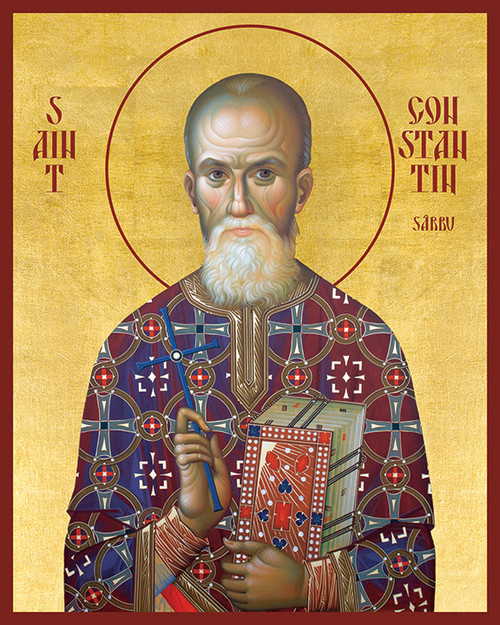

St. Constantin Sarbu + Commemorated on October 23
St. Constantine Sârbu was canonized by the Holy Synod of the Romanian Orthodox Church in the meeting of July 11-12, along with 15 other venerable confessors of faith during communism.
The Hieromartyr Constantine Sârbu was born in a poor peasant family on January 10, 1905, in Cavadinești, Galați County. His mother passed away when he was one year old while trying to give birth to her second child. His father, following an accident, was unable to care for himself or his child. Then, young Constantine was taken and raised by his grandmother, Ioana.
In 1919, at age 15, St. Constantine was admitted to the Theological Seminary in Galați, where he entered as a scholarship student, ranking third among 500 candidates. He was so thirsty for knowledge that he completed two years in one at the seminary despite working nights at a lumber factory. In 1925, he became a student in Bucharest at the Faculty of Theology and the Academy of Music. Still poor, he slept on the floor for two years, first in an attic in Amzei Square and then the North Railway Station’s waiting room.
He was ordained a priest for the diocesan cathedral in Huși, at the Holy Dormition-Adam Monastery, by Bishop Nifon Criveanu of Huși, then in the same year was appointed director and professor of the Cantors’ School, later being designated as archpriest of Fălciu. St. Constantine stayed in Huși until November 1, 1938, when he transferred to Bucharest, to the newly established Călărași Park parish, because his wife had received a position as a German and French language teacher at the Nicolae Bălcescu High School.
On January 12, 1954, he was arrested, passing through the prisons of Jilava (1954-1955), Gherla (1956-1962), and Dej (1955), and the labour camps at Poarta Albă (1955-1956) and Salcia (1959). Christ’s martyr endured many tortures in prison. He was burned with hot iron on his soles, had his beard torn out, and was beaten and humiliated to deny Christ. However, Blessed Constantine responded with spiritual courage: “You can torture me as much as you want, but I will not deny Christ.”
Released on January 10, 1962, he received two years of mandatory residence in Bărăgan, in Viișoara village. He returned to Bucharest in 1964, and Patriarch Justinian entrusted him with the Church of the Holy Wisdom. Alone, sick, hungry, in rags, with broken shoes, but full of confidence, St. Constantine arrived on June 1, 1965, at a church in ruins. The saint restored the church and gathered around him a Eucharistic community deeply involved in philanthropic activities.
St. Constantine Sârbu reposed in the Lord on October 23, 1975, at the age of 70.


