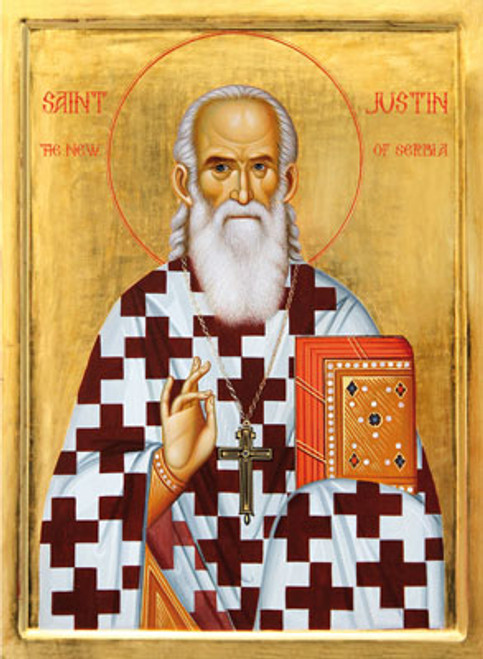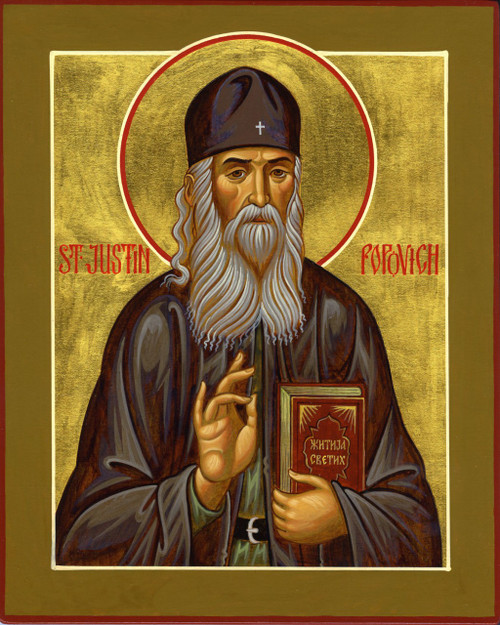


Blessed Elder Justin P̢rvu of Romania + Commemorated on June 16
Father Justin Parvu was born, according to the Registry of Secu Monastery, on February 10, 1919, the feast day of the Holy Great Martyr Charalambos, in the village of Poiana Largului (Petru Voda) in Neamt County, into the family of deeply devout Orthodox Christians. He was baptized with the name Joseph. From an early age he loved the beauty of the Christian faith, and in 1936 he entered the brotherhood of Durau Monastery. In 1939 he began his studies at the Seminary of Cernica. He made it his ideal to fulfill all the commandments of the New Testament, so that love for God and for his fellow man became the defining characteristic of his life.
Among his classmates were many of the great fathers and hierarchs of the Romanian Church, including Patriarch Teoctist, Metropolitan Bartolomeu Anania, and Archimandrites Sofian Boghiu, Grigorie Babus, Ioasaf Popa, and Gherasim Iscu. He showed great zeal for theological studies and ranked among the seminary’s finest students. After the closure of the Cernica Seminary by Marshal Antonescu, Father Justin continued his studies at the Seminary of Ramnicu Valcea. He was tonsured a monk in 1942, and in 1943, at the age of twenty-four, he was ordained to the priesthood in Iasi.
That same year he enlisted as a missionary priest on the Eastern Front [during World War Two], serving the Divine Liturgy for the soldiers until August 23, 1944, when he returned to his monastery. He continued his studies at the Seminary of Roman. The change in the political regime placed him in the difficult position of having to accept, as the senior student of the seminary, the office of president of the Romanian–Soviet Friendship Association within the school. Because he refused to endorse any of the Bolshevik initiatives demanded by the occupying authorities and instead devoted himself to lessons in Christian and national education, he was arrested on May 14, 1948, and sentenced to twelve years in prison.
The years of imprisonment were years of unceasing martyrdom for Christ through every means employed by the regime: hunger, cold, torture, beatings, humiliation, deprivation of sleep, light, fresh air, and human contact. Making use of moments that seemed unbearably difficult for the labor of prayer, Father Justin chose silence throughout those years, while his illustrious fellow sufferers in Christ—the intellectual elite of Romania, including Petre Tutea, Mircea Vulcănescu, Constantin Noica, Fr. Daniil Teodorescu, Fr. [now Saint] Dumitru Staniloae, Fr. [now Saint] Ilarion Felea, George Manu, Nichifor Crainic, and many others—an elite being systematically destroyed before his eyes, offered their love by giving university-level lectures to their fellow prisoners. By remaining silent and listening to each of them, Father Justin learned above all how to weep in the secret chamber of his heart.
His journey through the anti-Christian prisons was remarkable also because of the experiences that he was able to transform from terrible and demonic trials into opportunities for Christian perfection. Whenever possible, he celebrated the Divine Liturgy upon his own chest, administering the Holy Mysteries to many prisoners, some of whom stood at the very threshold of their departure from this world. He was tortured and interrogated at Suceava Prison until August 1949, when he was transferred to Aiud, the communist prison for intellectuals. He remained there until 1951, when he was sent to the forced-labor camp at Baia Sprie. He stayed there until 1954, when he was transferred to Gherla and later to other prisons. Concerning Gherla Prison, he later recalled: “I was no longer a person; I was a number: 267. They would not even allow us to call one another by name; we all bore numbers. Can you imagine such a thing?”
In 1960, when the sentence imposed upon him for believing in Christ had expired, he was asked what he intended to do after his release. He replied: “I will continue where I left off: serving the Church!” For these words he received an additional four years of imprisonment without trial, which he served in the Danube Delta, at the notorious labor camp of Periprava.
At the end of his sixteen years of imprisonment, Father Justin would say that he had lived through “the most important experience one can have in this life: to come to know oneself through suffering.” After his release on May 14, 1964, the first thing he did was to make his confession. Afterwards he went to his family home. Shortly thereafter, however, his mother Ana, whom he himself described as “a saint,” reposed in the Lord. Since the authorities would not permit him to return to monastic life, he worked for a time as a forestry laborer.
In 1966 he was readmitted to the monastic life at Secu Monastery in Neamt County, where he served as priest and spiritual father until 1974. Between 1974 and 1989 he served as priest and confessor at Bistrita Monastery near Piatra Neamt, where the communist authorities had established his forced residence under constant surveillance. There, together with other great spiritual fathers of that era, he devoted himself to the spiritual care of all who sought him out. Many of them chose even then the path of monasticism or the priesthood. His reputation as a wise confessor and gifted spiritual guide, though it brought him many difficulties from the authorities of the atheist regime, made him known throughout Romania and the wider Orthodox world.
After the events of December 1989, Father Justin returned to Secu Monastery, where he served as priest and confessor for nearly a year. In 1991, together with two other monks, Ignat and Calinic, he went to his native village of Petru Voda. With the blessing of His Eminence Daniel, then Metropolitan of Moldavia and Bukovina, he succeeded in laying the foundations of the Monastery of the Holy Archangels Michael and Gabriel. The fervent desire of the abbot was to dedicate the monastery to the Romanian martyrs of the communist prisons. Recalling those who had suffered in prison under communism, Father Justin said: “I miss them so much, and I rejoice far more at the thought that we shall see one another again than at the thought of being reunited with my own parents.”
In the year 2000 he founded the convent of Paltin, near Petru Voda, a monastery distinguished by its extensive philanthropic work, including a nursing home and hospital for elderly women, a boarding school for children, a medicinal-herb laboratory, and medical clinics. Alongside all these labors and ascetic struggles, Father Justin also supported the monastic life of other Romanian sketes. He established a periodical devoted to Orthodox teaching and witness, entitled The Voice of the Monks, and another publication dedicated to Romanian thought and spiritual life, entitled Attitudes. In 2008 he was elevated to the rank of archimandrite.
He reposed in the Lord on the evening of June 16, 2013, at the age of ninety-four, and was buried at Petru Voda Monastery, where he had served as abbot and spiritual father until the end of his earthly life. He remains in the memory of the faithful as a great spiritual father, a sacrificial witness to the Orthodox faith, and a tireless guide to all who sought him. His Beatitude Patriarch Daniel said of Archimandrite Justin that he was a great spiritual father, “a builder of souls and a founder of monasteries.”